

Too Many College Grads

What happens when there are too many college grads?
This week on the podcast I interview Noam Scheiber, the author of “Mutiny: The Rise and Revolt of the College-Educated Working Class.” Noam painstakingly interviewed and followed college-educated employees who tried to unionize stores and warehouses at Starbucks, Apple and Amazon for several years. He also followed a young Hollywood writer who was part of the 2023 strike.
“I showed up at one of the first Starbucks stores that tried to unionize in 2021 in Buffalo,” Noam relates. “I noticed that a lot of the unionizing workers were college graduates who had showed up to Starbucks as an interim gig but then found themselves there for years. I thought there was something to dig into.” He wound up following one Starbucks employee, Teddy Hoffman, for three years who had been working at a Chicago Starbucks location after graduating from Grinnell College as Teddy’s store voted to unionize.
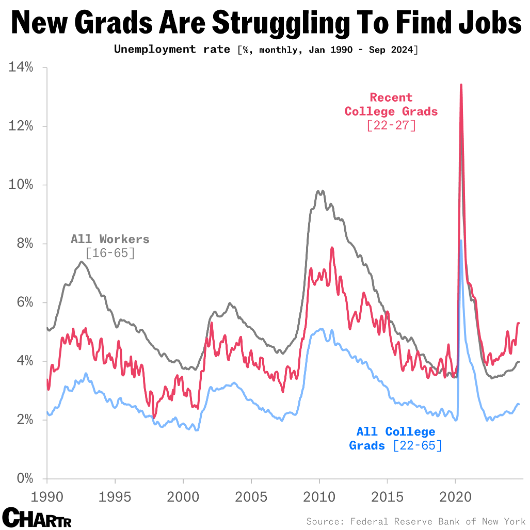
“Underemployment of college graduates is all over the news today because of AI,” Noam says, “but the truth is that it’s a trend that has been building for years. A lot of college grads went to work at Starbucks or Apple as a waystation job before the pandemic until they could get the kind of job they got a degree for, but instead found themselves semi-permanently part of the retail workforce.” Indeed, Teddy had already been working at Starbucks for seven years with his degrees in Theatre and English before unionizing, though he eventually became a teacher. “Because they’re college-educated, they have a certain worldview and confidence about them. I was impressed when they would just look up the details of the National Labor Relations Act, for example, to see what employers could and couldn’t do.”
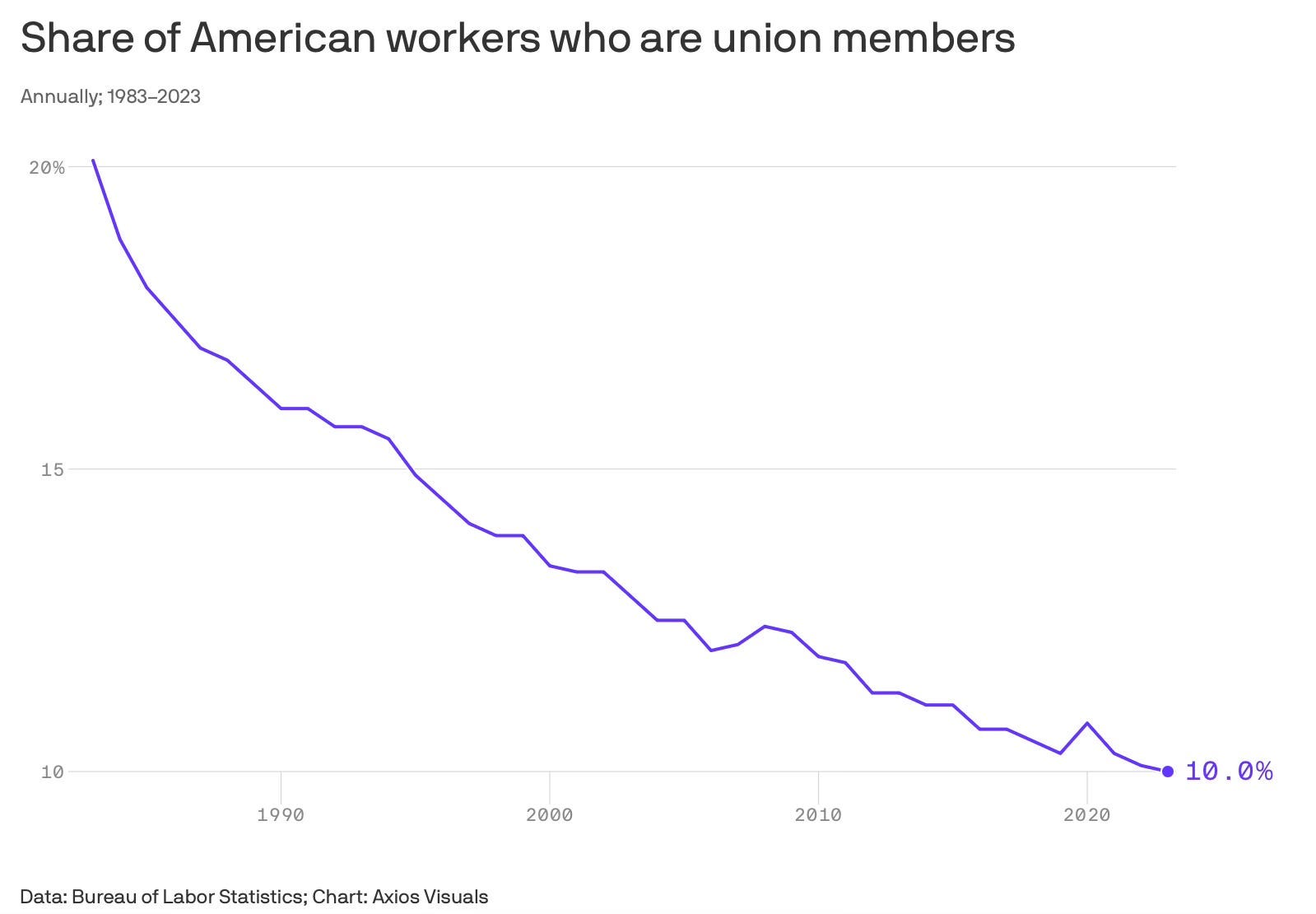
Where there were fewer college graduates, there were more social and cultural barriers to organizing. “Each Starbucks store was kind of the same in terms of the makeup of their employees,” Noam observes. “This is one reason why unionization at Starbuck stores spread to 650 locations, while at Amazon, it hasn’t translated to multiple fulfillment centers.” The 650 Starbucks stores in the U.S. represent about 6.5% of Starbucks’ 10,000 locations in the U.S.
One of the admirable aspects of Noam’s book is that it doesn’t sugarcoat how hard it is to unionize in these environments. “Technically, employers aren’t allowed to discriminate against workers who are looking to unionize. But any grievance with the National Labor Relations Board can take years, during which a lot of these employees might have already moved on. And employers can all of a sudden start enforcing rules that were always on the books that can make an environment very unpleasant or increase benefits for non-unionized stores.” For example, a worker could get fired or disciplined for being 5 minutes late because there’s a rule against tardiness that ordinarily doesn’t get enforced, or non-union employees could get a new benefit that unionizing stores don’t get because any new benefit has to be collectively bargained.
Indeed, the human aspect of “Mutiny” is its most compelling aspect; seeing Teddy and other retail workers try to organize over months and years makes you feel for them. Teddy becomes a father for the first time, and he and his wife apply for government benefits because money is short and Starbucks has reduced his hours. But he continues on because he wants to see the campaign through.
So what lies ahead? Noam says, “One thing I can say with confidence is that this population is going to change our politics. Young college graduates voted for Zohran Mamdani, for example, at a rate of 84%. When do you see a number that high?” Indeed, one of Peter Turchin’s conditions for revolution is an oversupply of elites. The ambitions of young people can go dark pretty quickly when the future they were promised fails to materialize, which is unfortunately going to be the case for more and more of them as 42% are currently underemployed - and rising.
When I ran for President I was more likely to talk about truckers or retail workers than I was college grads being displaced by AI. But every 23-year old who returns home to their parents' house with stifled ambitions and deferred dreams represents a big lost opportunity. As that becomes the new normal, the costs to both the individuals concerned and the country will be profound.
For a link to Noam’s book, click here and for my convo with him click here. I started a wireless company that will reduce your time on social media and save the average American $500 a year. Go to noblemobile.com/yang for 3 months off your wireless bill, the best deal around that will also reduce your screentime and help you save for your family or email matt@noblemobile.com to get a human being. The Hudson Valley Ideas Fest returns to Rosendale, NY on April 25th. Go outside and look up.
To some degree, you get what you incentivize. Easy access to student loans made it too simple to enter the college system—repayment was someone else's problem later. That flooded the pipeline and encouraged the proliferation of degrees with weak economic returns, contributing to the 42% underemployment Yang describes.
Compounding it: grades have inflated dramatically, making it far too easy to 'succeed' in college with minimal rigor. When the real world hits without those artificial props, the shock is greater. Instead of adapting, some try to reshape the workplace (or broader society) to accommodate their inflated expectations and outcomes. This dynamic helps explain the surge in organized labor efforts among degree-holders in service jobs.
Redirecting talent toward high-value societal needs—like the regenerative work Yang proposes—could break the cycle better than more credentials.
There’s plenty of work that needs to be done: shift cultural values and prioritize regenerative forestry, agriculture, and landscaping to restore biodiversity. This would heal the water and carbon cycles to turn down the heat, rehydrate desertified spaces, and sequester carbon. All to address the biggest threat to humanity. A large young workforce could do wonders of good on jobs that matter. Generally see bio4climate.org.