


Hello, I hope that your summer is going great. I had a lovely 4th at a friend’s barbecue.
As you know, I ran for President in 2020 with the main idea that AI was going to come along and do a number on jobs. I believed that advancing Universal Basic Income was the best hope that we had of managing this transition. I wrote a book, The War on Normal People, making this case and then stumped around the country for months rousing millions of Americans. You might have been one of them.
How am I feeling now?
I’ve been reading a lot of the work compiled by the economist Molly Kinder, whom I recommend. She, like Clara Shih, believes that even if AI doesn’t wipe out all of the jobs, we are in for “a hard, messy period of concentrated pain with job losses clustered in specific, desirable jobs. . . the work that AI is most directly capable of replacing is cognitive work performed at a computer - in offices and professional sectors. These are precisely the jobs that have grown the most as a share of the American labor force over the last fifty years.”
Here is one of her favorite charts, which shows the general trends in the types of work that most Americans do:
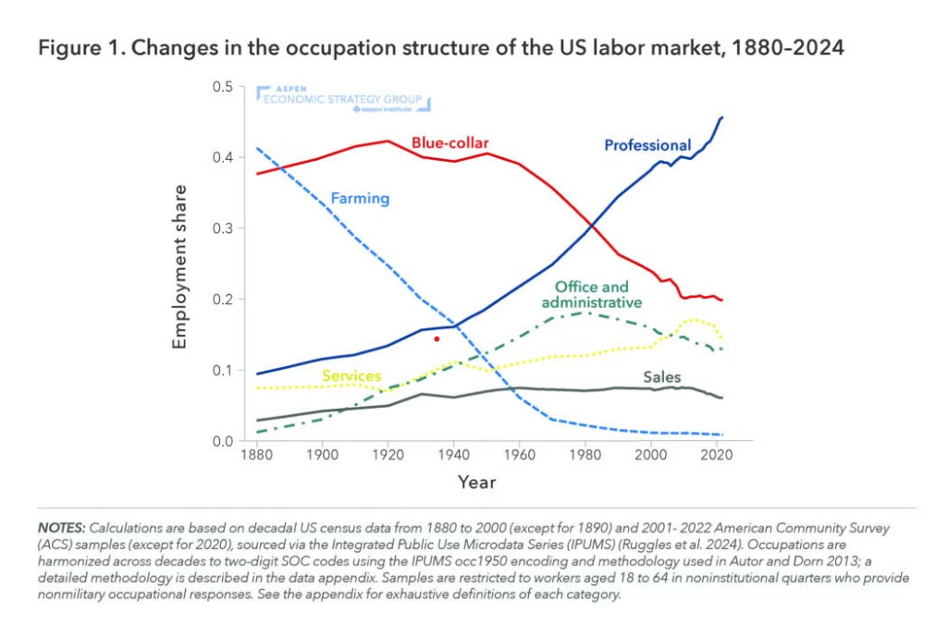
Farmers famously went from 40% of workers to 1% of workers in the last 140 years.
Office and administrative jobs peaked around 1980 and are now declining.
Services jobs peaked in 2015 or so and are now declining.
Meanwhile, professionals have grown to be almost half of all jobs. ‘Professionals’ is used very broadly in this particular study: it includes managers, marketers, business and finance operations, coders, mathematicians, architects, engineers, lawyers, teachers and educators, journalists, scientists, dietitians, doctors, nurses, health technicians, accountants, librarians, social workers, guidance counselors, artists and designers, actors, physical therapists, etc. You can see the source data here. Pretty much anything that requires a college degree gets lumped into this category. College graduates are about 36% of the population of the U.S. and 45% of the workforce.
Molly describes this decades-long transformation of the labor market as increasing rewards for cognitive skill, accruing largely to college graduates. “First, agriculture collapses as a share of employment over a century. Blue-collar manufacturing rises and then falls. Office and administrative support rises and then drops. And through it all, professional and managerial work climbs steadily upward. The skill premium has been one of the most durable features of the modern economy.”
Molly then forecasts that AI is about to extract the premium from cognitive work. “If cognition itself becomes commoditized, the scarcity premium that has rewarded the college-educated knowledge class for generations starts to compress. The chart I keep staring at is the one I’d want to draw next: the same occupational clusters, projected forward, with the professional band starting to bend downward for the first time in a century . . . What we face is not a transition to a stable new shore. It is an economic transformation of historic scale, one that threatens the best jobs we have and the very notion of work as we know it.”
Yup. AI is going to sharply reduce the number of professionals in the economy. It’s starting with recent college graduates and the rank-and-file of banks and tech firms, but it’s going to expand very quickly.
What do we do for a living? A lot of us think. The thinking is going to be done for us more and more by AI. Imagining that this won’t transform the nature of work is fanciful.
Molly is particularly concerned about clerical and backroom jobs that serve as paths to the middle class for millions. And, to her credit, she doesn’t think retraining is a viable solution for most workers.
How do I feel about the case I made back in 2020? It’s aged well. I wish I was wrong, but I don’t think I was. The question is what, if anything, are we going to do about it.
I’ve been interested in what we could do with money for a while now. For my interview with financial journalist Brendan Greeley on his book “The Almighty Dollar: 500 Years of the World’s Most Powerful Money” click here. To check out Forward Party candidates in your area, click here. To get a copy of “Hey Yang, Where’s My Thousand Bucks?” click here and use the code “UBIUBI” for 25% off. I’m doing a book talk in LA on July 22nd. For 3 months off your mobile bill with Noble Mobile, click here or email matt@noblemobile.com and use my name to switch or explore. Look up this summer.
Thank you Andrew. I rely on your voice in all of the noise. I'm a Franchise Broker (part of the professionals group you wrote about today) and I see that role also being reduced / eliminated at some point. It's going to be rough.
Have you had any discussions with Tony Seba and the folks at RethinkX? They have a pretty optimistic view of these disruptive technologies like AI but also understand that the transition could be awful if we human beings can’t manage it well. I think it’s critical that we elect politicians who really understand this challenge, it seems like those on the right will just let market do it’s thing while those on the left only talk about 20th century ideas like unions and retraining.