


A friend recently told me that she and her husband sold their house to pay for their daughter attending a private university. I said, “Really?” in a tone that made it seem that I didn’t necessarily agree with the decision.
“It was her dream school,” she explained. “It’s also where both her Dad and I went. And she’s our only child. It seemed wrong to deny her something that we both had. Plus, she wants to work in the arts so going to the right school seemed important.”
I met their daughter and she seems very happy and successful and is indeed working in the arts. So on that level, it’s tough to argue with her parents’ decision. On the other hand, I found myself thinking that owning that home could come in very handy if they or their daughter run into a rough patch.
“You’d do the same thing for your kids, I bet,” my friend continued, being a bit overly generous in her estimation of my character. I responded, “My parents mortgaged the house to send me to college,” which was true, “so I suppose I would do the same for my kids.” The problem wasn’t my love for my kids, but I just am not the kind of believer in a college education being the end-all-be-all as my parents were in the late 80s and early 90s.
I wrote last week:
School loans will become all the more burdensome without the ability to get a high-paying job. Many young people will be faced with getting a job that doesn’t require a degree while paying for the one that they got at great expense.
Basically, the education premium is going to be sharply reduced with AI’s arrival; many degrees will become devalued. Dozens, perhaps hundreds, of marginal colleges are going to close over a number of years. The ones that remain will be asked to prove their value in various ways, with the elite doing fine and the others struggling or evolving.
If you’re weighing going back to school or sending your child in this direction, question the cost of the degree heavily, as the cost-benefit is changing – for the worse – in real time. If it’s low-cost, vocational or top-tier, you’re fine. If it’s expensive and doesn’t lead to a concrete opportunity… maybe re-examine it.
Ten years ago, if an individual asked me whether it was worth it to take out loans to attend a more prestigious school, I probably would have said “Yes” because the return on investment would likely be positive for that person. The gap between the professional and personal advantages of attending, say, a top 30 school versus a less selective school would probably be greater than the additional expense, even if that was significant (e.g. $100,000+).
Today, I might not say that. The debt load today would be more daunting and the advantage to having a fancy degree may be lower. The kid with the costly degree might be just as unemployed as the person from the cheaper state school, plus they might owe six figures or more. It might be better for them to make the most of a less expensive education and grow from there.
AI is going to blast away many – perhaps most – of the entry-level jobs that a new college grad was going to occupy. A professor at a national university told me, “For the first time I have alums, Computer Science grads, calling me saying they’re still without a job, and they’re driving an Uber to make ends meet.” I meet young people who describe that kind of situation all the time.
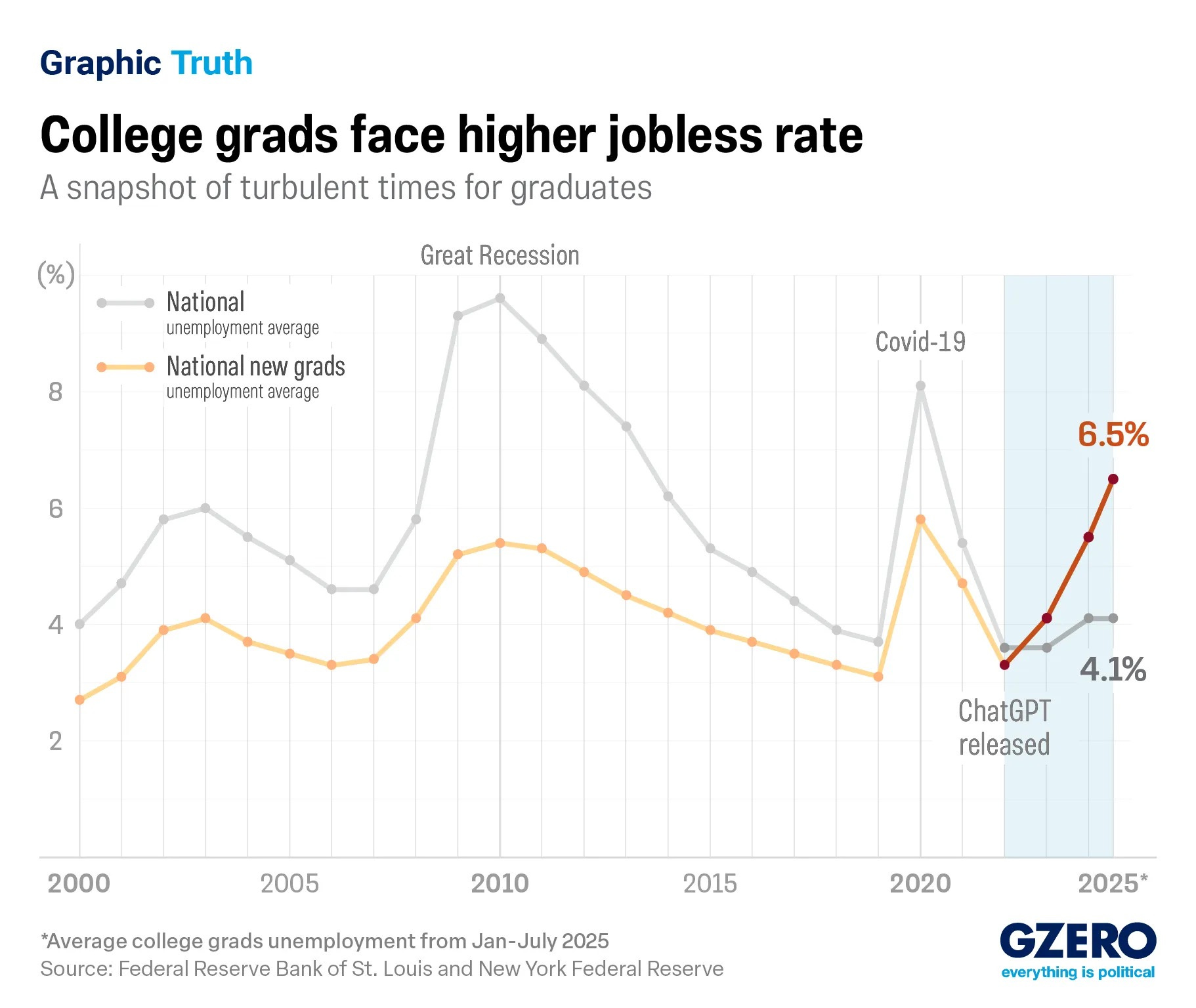
Americans are losing confidence. 63% of Americans now feel that college is ‘not worth the cost because people often graduate without specific job skills and with a large amount of debt to pay off,’ up from 47% in 2017 and 40% in 2013. Their feelings are borne out by recent stats. According to Fortune, only 12% of current college seniors secure a full-time job by graduation, versus 40% for earlier generations. Americans with college degrees now make up a record 25% of all unemployed. Men with college degrees are unemployed around the same rate as men without degrees. 52% of recent grads are doing jobs that don’t require a degree. The college premium is evaporating.
Weaker colleges won’t exist 10 years from now. I know of one – King’s College – that went out of business in New York City in 2025. The Federal Reserve Bank of Philadelphia predicts dozens of closures as soon as 2029. The most vulnerable schools are small regional, non-selective colleges with low endowments and/or high debt. A huge red flag is any significant drop in enrollment, which often precedes a drop in viability, or selling of assets to meet a budgetary shortfall.
Yes, we are at the point in American life where it’s a good idea to examine the financial strength of any college you look at to make sure it will still be here 10 years from now.
For many families, it’s not no college vs. college, but more a public university (cheaper) vs. a private university (more expensive, unless you get aid). Another choice might be to get some credits at an inexpensive community college and then try to transfer in your sophomore or junior year.
That said, if employers decide to hire, they’re going to try to take from the top. A Wall St. Journal article last month outlined that McKinsey, a top consulting firm, has shifted its recruitment from dozens of universities to only 20 core schools such as the Ivies, Vanderbilt and Notre Dame. Similarly, GE Appliances has shifted from 45 schools to 15 select universities. Employers are going narrow in their recruitment.
All of this makes sense; if you’re going to hire fewer people and you expect young people to be itching for an offer, you’d probably try to cherry pick.
I hire people, even now. I interview folks who want to join Noble Mobile, for example, some of them right out of college. What do I look for? A spark of some kind. People with energy and commitment. Being good at something and excited about it, whether it’s drama or sports or contributing to an organization.
Cognitive qualities and an academic record may become less important in the AI age relative to other qualities like demonstrated grit, social skills or work experience (or, unfortunately, personal connections). Employers might want to hire people who are consistently delightful or tough, which doesn’t necessarily map to SAT scores. So being a high-performing athlete, a talented singer / dancer / actor, or the head of student government could be more important than how smart you are. A particularly dark example: drug companies used to hire college cheerleaders to head to doctors’ offices because the doctor would be much more likely to talk to them.
One thing I personally think will be a competitive advantage for college students - reading books for pleasure. It will be such a rarity that being highly literate will set you apart. Most businesses still run on emails and words – anyone capable of writing coherently and clearly will be hireable, if they can demonstrate this capacity. Being able to write means you can think. This will be a mild bias among employers of a certain vintage (e.g. folks like me).
Another major finding: employers will try to recruit from campuses physically near them. Think about it if you’re the employer - would you recruit from your local school? Sure, because it’s convenient and inexpensive to do so, it buys you goodwill with your community, and the new hire already has ties to the region and is more likely to stay long-term. So if your child has a hankering for a particular region or industry, going to school in that city or region makes sense.
The Wall St. Journal summarized it like this: “The ‘talent is everywhere’ mantra adopted by U.S. employers when the job market was white hot is giving way to a more traditional entry-level recruiting strategy: hire from a few select universities.” So the upside of going to one of the top schools is going to be higher relative to other more anonymous schools. In a land of diminished opportunities for knowledge workers, it might be more vital than ever to have a personal network from an elite school in order to get an appealing job.
You can think of colleges as more of a barbell, where the top makes sense, and maybe the bottom too if it’s inexpensive, but the full-priced middle is increasingly tougher to defend.
By the way, the math here may miss the point of college for a lot of people. Numerous studies show that college graduates are happier and more optimistic than those who did not attend college. Some of this can be explained by income effects, but some of it is independent of the money. College functions as a maturation environment that is social as much as it is intellectual or academic.
When I look back on my college years, you know what my strongest memory is? Falling in love with my college girlfriend, and then having to get over her because she left me for another guy. Having my girlfriend go from my best friend who I saw every day to a stranger hanging out with another guy rocked my world. I was morose for months. I got into a car accident. I had trouble getting out of bed. I dragged myself to the gym each day as a way to say, “Well, at least I did something today.”
What did I learn in college? How to deal with a breakup. Kind of an important life skill.
Now, I also took a bunch of courses and got an Economics degree. Labor Economics was my favorite course. Professor Cheit helped explain public policy to me. So I did some learning in the classroom too. But college was a place you could go from a quasi-kid to something of an adult with a blend of both freedom and modest responsibility. It’s a social crucible of group projects and failed advances and student organizations and Tae Kwon Do clubs.
College and universities are going to be beset with challenges moving forward, and many are going to struggle to fill seats as AI takes away the presumption of employment for new grads. If a family is of limited means, the debt is going to be very real while the benefits might be tough to identify.
Are my kids going to college? Almost certainly yes, unless one of them becomes a savant entrepreneur or a complete shut-in. They’re studious kids whose parents both have advanced degrees and we can afford it. I’m still Asian, after all. The benefits to college are much more multi-faceted than what your first job looks like or even your earnings over the next decade-plus. Education, college or no, should be about the formation of personhood as much as it is your job skills. Your best teachers taught you to care about something as much as to know something.
The point is, it’s going to be a rougher tradeoff economically. A generation ago, sacrificing a ton of resources to get a child through college or to the best school possible was a solid ticket to a middle-class career and maybe even more. Today, that’s a shakier proposition. Families are going to be grappling with what to tell their kids and whether they should try to push them in a different direction.
I would certainly encourage more people to pursue trades that will be less likely to be overtaken by AI. Think jobs that involve working with kids, sick people, being outside a lot, being an electrician, HVAC repairperson, nursing, that sort of role. We are short hundreds of thousands of tradespeople and these jobs will be more resilient. Vocational schools, trade schools and apprenticeships should be made available to many more young people and prized as smart decisions.
But on a personal level, I get it if young people want to do what Mom and Dad did, even if the time they’re growing up in is going to be very different, and harsher by the numbers. The promise of an education leading to an awesome career is fading as AI soaks up the thinking, while the debt will remain.
Some takeaways:
1) People will still be going to college for the foreseeable future.
2) If you get into a top school, it’s probably still worth it.
3) Recruiters will start to cherry pick and aim for the top.
4) Weak schools will die. Definitely don’t attend one. Many colleges will struggle.
5) If it’s an unremarkable or not-so-great school AND expensive, you might want to rethink it or find a way to cut the costs (for example, by attending an inexpensive school for a year or two).
6) A school being physically near an industry or company you are excited about should be considered as a plus factor.
7) Personal qualities – and ways to demonstrate them – will grow in importance for employers.
8) Networks will still matter. Indeed, they might matter more.
9) There are non-economic reasons to go to schools that revolve around identity and social development. It’s okay to accept that.
10) The promise of a career in knowledge work may or may not be there for this generation, but the debt will be real.
I’ll be on the book tour in LA, SF, and Seattle this week - check dates here. Offline is coming back to SF this week. To start saving money on your data, check out noblemobile.com/yang for 3 free months off your wireless bill. Look up.
Lots of good information here, Andrew, but here’s my takeaway: Sentimentality is SILLY! I see it all the time. Major decisions made on reasons such as “We went there”, “She has her heart set on it,” and so on. The couple you cited at the beginning will live to regret this foolish decision- perhaps they already do. Good luck to them - they’re gonna need it.