

The End of the Office

I write this filled with sadness.
Last week, I wrote about how AI is now replacing white-collar workers in earnest as Claude’s Co-work released plug-ins for legal, financial and marketing functions. Social media is filled with accounts from long-time software developers declaring themselves obsolete based on AI’s capabilities right now. Physicists report the same.
Someone in my family had AI program a website for them this week. It completed in minutes what used to take a designer or a firm days of work.
How many roles essentially consist of processing information and then presenting it to someone to make a decision? Now not only the process and report will be automated, but perhaps the decision as well.
This will result in the great disemboweling of white-collar jobs.
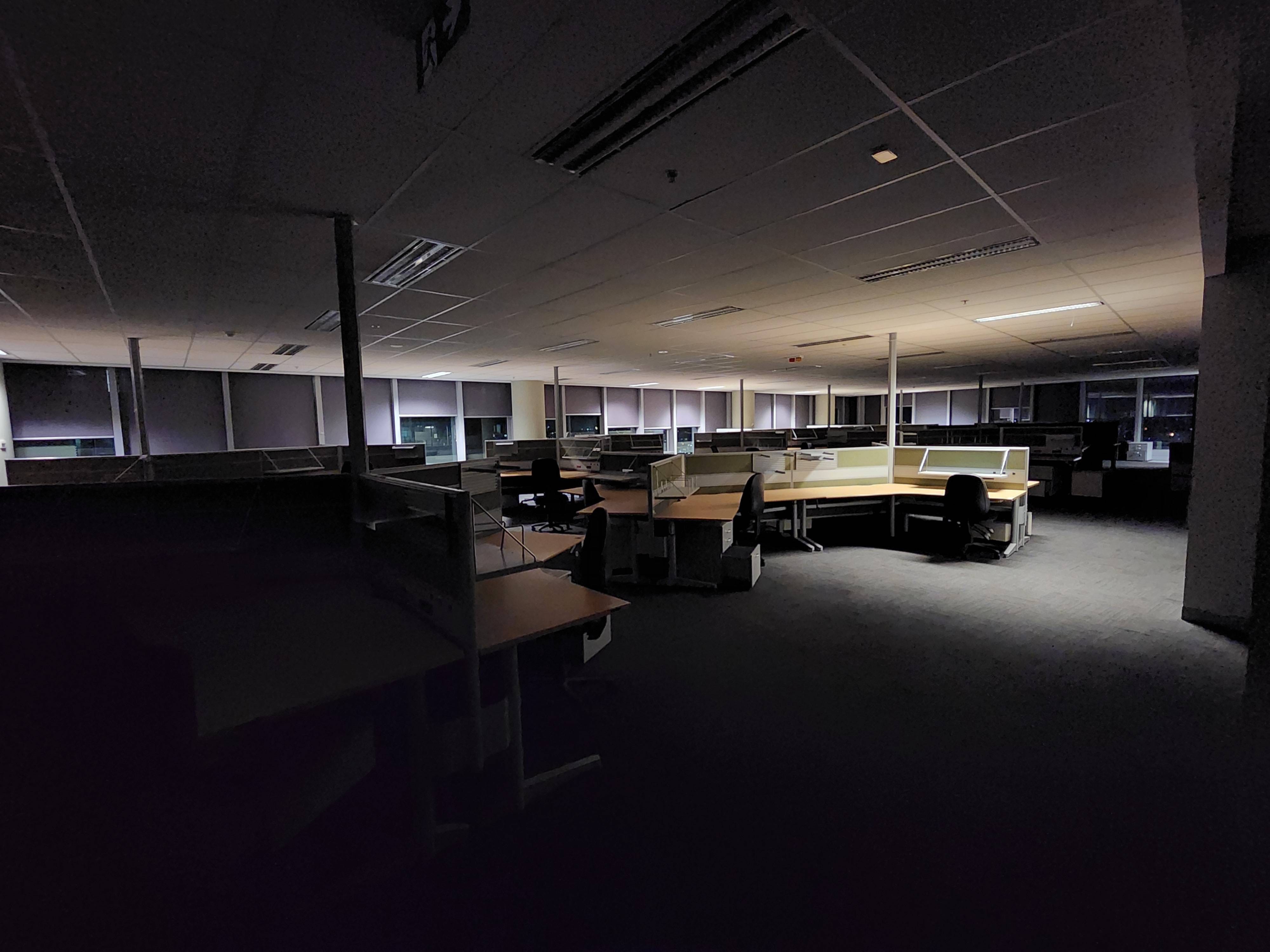
This automation wave will kick millions of white-collar workers to the curb in the next 12 - 18 months. As one company starts to streamline, all of their competitors will follow suit. It will become a competition because the stock market will reward you if you cut headcount and punish you if you don’t. As one investor put it, “Sell anything that consists of people sitting at a desk looking at a computer.”
I’ve started to call this displacement wave the Fuckening because that feels more visceral.
Do you sit at a desk and look at a computer much of the day? Take this very seriously.
I want to forecast a few of the immediate social impacts of the Fuckening:
1. Mid-career office workers will be fired in droves. Right now, there are about 70 million white-collar workers in the United States. Expect that number to be reduced substantially, by 20 – 50% in the next several years. Even a reduction of several million would be tectonic, and I fully expect it to go well beyond that level. Major firms are firing people right now. I spoke to the CEO of a publicly traded tech company. He said, “We’re firing 15% of workers right now. We’ll probably do another 20% 2 years from now. And then another 20% 2 years later. After that, who knows?”
Millions of workers are about to be given their pink slips.
The most vulnerable are middle managers who have become more expensive. What will they do next? They’ll look for another job. Good luck with that as job search times have already been climbing and corporations are going to be loathe to hire. Many will find something part-time to pass the time. One friend of mine who lost his job began volunteering with a local non-profit that now might want to pay him to manage their IT infrastructure. The pay would be 80% less than what he used to make, but he might wind up taking it. There will be a ton of similar downgrades ahead.
Expect the Starbucks in your local suburb to become occupied with middle-aged former office workers who want to get out of the house. That’s a benign portrait, but a lot of these families still owe mortgages on their houses that they won’t be able to maintain. If I were a homeowner in Silicon Valley or Westchester County, I might consider putting my house up for sale to see what I could get because there’s going to be downward pressure on these communities. It might not feel great being first, but you don’t want to be last.
It won’t just be the managers. It will be the call-center workers, the marketers, the coders, the financial forecasting teams, and on and on; business functions are going to get compressed into a handful of key employees supplemented by AI.
In essence, the number of people necessary to make large corporations function is going to be dramatically reduced. What do you say if your child asks you about becoming a newspaper journalist? You say, “Well, that field hasn’t really been growing, you might want to consider something else.”
Substitute “programmer/designer/accountant/lawyer/finance/marketing/consulting/analyst/researcher/anything-that-involves-looking-at-a-computer-and-going-to-an-office” and you’ve got the right idea.
Basically, brainpower is now a commodity that is going cheap.
If you are one of the professionals who is likely to be affected, I’m sorry. But this is real. Cut your expenses and take precautionary measures, because there will be many people losing their jobs and you could easily be one of them. This has left the lab and is now at a desk beside you. Only it doesn’t even need a desk – too expensive.
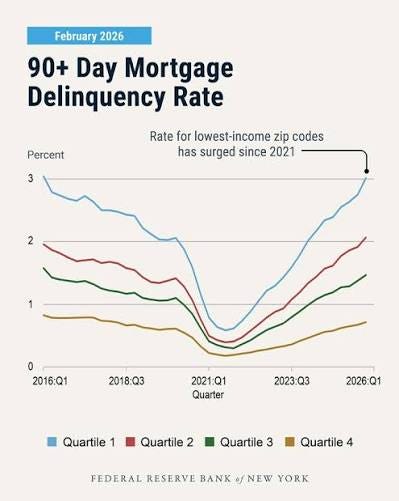
2. Personal bankruptcies will surge. Americans are in general already on unsteady ground financially, but that’s going to get much much worse. Millions of Americans of every walk of life are about to see their way of life threatened. If you lose your job, you typically can get by for a little while on savings, but then it gets rocky pretty quickly. Here, you can see mortgage delinquency rates are already on the rise.
Even if you’re not an office worker, you may be affected. Let’s say you’re a drycleaner or a dog walker or a hairstylist. If people in your community stop going to the office, your business is going to suffer because there are fewer business shirts to launder, people will walk their dogs themselves and cut back on trips to the salon, etc.
The amount of money getting paid to human labor is about to go down. The value is going to get soaked up into the cloud. The K-shaped economy, where the rich enjoy the growth and keep spending while the bottom 80% or so are trying to tread water will become all the more dramatic.
People and families are going to be left behind in large numbers.
Of course, where financial ills and stresses increase, social ills follow in terms of broken relationships, addictive behavior and despair.
I’m sorry I don’t have better news here. But it’s going to get very rough out there for a lot of people. Make a plan. Be adaptable.
3. College grads won’t be able to find jobs. Already, the proportion of seniors who find a job in their field has dropped to 30% and underemployment of recent grads is up to 52%. Enterprises that used to need an annual flow of whippersnappers are now firing some of last year’s whippersnappers. A ton of people will be moving home with Mom and Dad or trying to hide out in graduate school.
School loans will become all the more burdensome without the ability to get a high-paying job. Many young people will be faced with getting a job that doesn’t require a degree while paying for the one that they got at great expense.
Basically, the education premium is going to be sharply reduced with AI’s arrival; many degrees will become devalued. Dozens, perhaps hundreds, of marginal colleges are going to close over a number of years. The ones that remain will be asked to prove their value in various ways, with the elite doing fine and the others struggling or evolving.
If you’re weighing going back to school or sending your child in this direction, question the cost of the degree heavily, as the cost-benefit is changing – for the worse – in real time. If it’s low-cost, vocational or top-tier, you’re fine. If it’s expensive and doesn’t lead to a concrete opportunity . . . maybe re-examine it.
4. Downtowns and office parks will empty out. What to do with all of this office space? Many commercial districts struggled through COVID and work-from-home. This will get considerably worse. Commercial buildings are generally very difficult to convert to some other purpose (i.e. residential) because of the floor plans, plumbing and the like.
This will become an overhang in New York, Chicago, Los Angeles, San Francisco and other cities with significant office districts. Not that long ago, these offices were a source of significant tax revenue. Their devaluation will hurt municipal balance sheets for years and make cities less able to provide services in other neighborhoods. Washington D.C. should be on the list too but mass layoffs in agencies are more of a political choice and most of those workers are unionized. Major urban centers will become less central and vital with AI, and empty office blocks will become the norm. Think urban wasteland and eerie downtowns leading to municipal tax hikes and declining services.
5. Pessimism and anger will rise up. I saw a note on social media that said, “Do you really think politicians will let millions lose their jobs? They’ll ban AI first.”
Has this person been paying attention? Go talk to the manufacturing workers or the journalists and see how it worked out. Hundreds of billions of dollars have not been spent on this technology for corporate juggernauts to stop now, and most officials have been cheerleading what they see as progress. The genie is out of the bottle.
But yes, people are going to be pissed.
The social contract of ‘study hard, go to school, get a good job, live a decent life’ is about to be vaporized to smithereens. Upward mobility for most will be a thing of the past.
People are not going to take it well. Particularly educated people who think that they deserve better. That’s an ingredient for revolt.
There’s been a lot of talk this past year about how young people are lurching to the left, the growing popularity of socialism in the Democratic Party, and Zohran Mamdani as emblematic of the next wave of leaders.
Imagine what people are going to think when we all feel like serfs to AI overlords that have soaked up the white-collar work?
Everything that has preceded this will be tame compared to what’s coming in terms of anger, despair and unrest. It won’t be very clear or organized, but people increasingly will feel like they have less to lose.
I argued in The War on Normal People that capitalism has done a lot to bring people out of poverty, but capitalism plus AI will be no one’s idea of a desired result, and that we have to advance the economy to revolve around people. That would start with Universal Basic Income.
I’ll have more to say about this as time goes on and the impact becomes clearer. But I’m deeply saddened. As the guy who jumped up and down for the better part of 3 years saying “AI is coming, it’s going to wipe out millions of jobs!” I know that we could and should be doing much more for the people and families of this country. In the absence of that kind of coming together, we are left with every-person-for-yourself in the face of the greatest technological transformation of our lifetimes.
Expect it to get incredibly, intergenerationally rough out there. Batten down the hatches, and do what you can for yourself and those around you.
- Andrew
I’ll be on the book tour in New Jersey and DC this week and then out West next week - check dates here. Offline is coming to DC this week and SF next week. To start saving money on your data, check out noblemobile.com/yang for 3 free months off your wireless bill. Make good decisions.
At some point I would love for someone to explain how large corporations and high level execs/leaders who are supposed to be thriving due to AI are going to be so profitable when as many people as you estimate will be unemployed, have no medical insurance, etc., will be paying for the products that all the AI companies excitingly dumping their employees will be offering? Use simple examples like iphones or streaming services etc? Will unemployed people surviving on growing their own vegetables be buying $1500 smart phones or buying expensive Meta Glasses? Will all these unemployed people be paying for Netflix and the myriad of streaming services they pay for today? Someone recent said on CNBC that "with people having so much free time after AI takes their jobs, they will be able to do what they love like go to sporting events and concerts, etc. which is why we are investing so much money in the sport industry." Really? All these unemployed people will be buying tickets that cost hundreds of dollars, to go watch an NFL game? Or unemployed people will be buying 5 streaming services so they can watching their favorite sports everyday?? I feel like no one ever talks about corporations who leverage AI, which if course they will, when half of the people/customers/consumers don't have disposable income.
Andrew, I would love to hear you talk about the need for a Small Business First coalition and an economy that's based on prioritizing small business over big business. After all, it is big business, major corporations that are driving AI.
Don't you agree that we need to have an economy that is local as opposed to one that is driven by major corporations? The whole paradigm that we've grown up with is that we want big businesses in our state because it looks good And employs lots of people.
Well that's the past. Wouldn't you agree?
Local economies based on small business have higher degrees of diversity and therefore strength. They have more stratification, more opportunities for employment and creativity, job satisfaction, and life satisfaction.
I'd love to hear you talk about this. What other thought leaders are talking about this? What states are changing their laws to create a Small Business First set of policies?